Chain of Custody for Soil Samples
The definitive guide to maintaining legally defensible chain of custody documentation for environmental soil sampling programs.
Chain of custody for soil samples is the documented, unbroken record that tracks every person who collected, handled, transported and received each environmental sample from the moment it is collected in the field until the laboratory completes its analysis. Proper chain of custody (COC) ensures sample integrity, prevents tampering or contamination, meets regulatory requirements and provides the legal defensibility needed for contaminated site assessments, regulatory submissions and environmental litigation. A broken chain of custody can invalidate laboratory results entirely, requiring costly resampling and project delays.
This guide covers everything environmental professionals need to know about chain of custody - from the information required on COC forms and proper sample handling procedures through transport protocols, laboratory receipt processes and digital COC management tools that eliminate the errors and inefficiencies of paper-based systems.
Why Chain of Custody Matters
Chain of custody is not just a bureaucratic formality. It is the foundation of data defensibility in environmental science. Without proper COC documentation, even the most carefully collected and accurately analyzed samples can be challenged and dismissed.
Legal Defensibility
Environmental data is frequently used in legal proceedings - contaminated site liability disputes, regulatory enforcement actions, insurance claims and real estate transactions. In these contexts, the chain of custody record must demonstrate that:
- Samples were collected by qualified personnel using appropriate methods
- Samples were properly preserved and stored at the correct temperature
- Samples were not accessible to unauthorized individuals at any point
- Every transfer of possession is documented with signatures and timestamps
- Samples arrived at the laboratory in acceptable condition within holding times
Regulatory Requirements
Major regulatory frameworks require chain of custody documentation:
| Framework | COC Requirement |
|---|---|
| EPA SW-846 | Mandatory for all samples submitted under federal programs |
| ASTM D4220 | Standard practice for preserving and transporting soil samples |
| ISO/IEC 17025 | Laboratory accreditation requires documented sample receipt and custody |
| BC CSR Protocol 4 | COC required for all analytical data submitted under the Contaminated Sites Regulation |
| CCME Guidance | National guidelines specify COC as essential element of data quality |
| Ontario Reg. 153/04 | Phase II ESA procedures require COC for all samples |
Data Quality Objectives
Chain of custody is one of the pillars of a Data Quality Objective (DQO) framework. Together with proper sampling design, field QA/QC (duplicates, blanks, trip blanks) and laboratory QA/QC, COC documentation ensures that analytical results meet the precision, accuracy and completeness requirements needed for decision-making.
The Chain of Custody Form
The COC form is the central document in the custody record. While formats vary by laboratory and organization, every COC form must capture specific information to be considered complete.
Required Information
Common Mistakes on COC Forms
- Illegible handwriting: The number one source of COC errors. Laboratories cannot analyze what they cannot identify.
- Missing collection times: Critical for confirming samples were analyzed within holding times.
- Inconsistent sample IDs: Sample labels must match COC form entries exactly. A discrepancy creates a custody gap.
- Unsigned transfers: Every person who takes possession of samples must sign and date the COC.
- Omitted preservative information: Labs need to know what preservatives were used to assess method compliance.
- Missing QA/QC designation: Failure to identify field duplicates means the lab may not apply appropriate QC procedures.
Sample Collection and Handling
Proper chain of custody begins the moment a sample is collected. Field procedures must ensure that samples are representative, uncontaminated and properly documented from the start.
Collection Procedures
- Prepare containers in advance: Pre-label all sample containers with waterproof labels showing sample ID, date, time and project number before going to the collection point.
- Wear clean gloves: Change gloves between each sample location to prevent cross-contamination. Use nitrile gloves (not latex, which can introduce contaminants).
- Collect the sample: Use decontaminated stainless steel or disposable sampling tools appropriate for the target analytes. Fill containers with minimal headspace (except for VOC samples which require zero headspace).
- Add preservatives: Apply chemical preservatives immediately if required by the analytical method. Pre-preserved containers are preferred to reduce field error.
- Seal and label: Secure container lids tightly. Verify label information matches the COC form exactly. Apply custody seals across container lids.
- Place in cooler: Immediately place samples in an insulated cooler with ice or frozen gel packs. Target temperature is 4 degrees Celsius plus or minus 2 degrees.
- Record on COC: Enter all sample information on the chain of custody form immediately after collection. Do not wait until the end of the day.
Container Requirements by Analyte
| Analyte Group | Container Type | Preservative | Holding Time |
|---|---|---|---|
| VOCs/BTEX (soil) | 40 mL glass VOA vial or EnCore sampler | Methanol or sodium bisulfate | 48 hours (unpreserved), 14 days (preserved) |
| PHCs (soil) | Glass jar, 250-500 mL | Cool to 4C | 14 days |
| Metals (soil) | Plastic bag or glass jar | Cool to 4C | 6 months (most metals) |
| PAHs (soil) | Glass jar, 250 mL | Cool to 4C | 14 days |
| PFAS (soil) | HDPE container (no glass) | Cool to 4C | 14 days |
| Asbestos (soil) | Sealed plastic bag | None | No limit (stable) |
Transport and Laboratory Receipt
Packaging for Transport
Samples must be packed to prevent breakage, maintain temperature and protect custody integrity during transport:
- Use rigid, insulated coolers with secure latches
- Pack ice or gel packs around and between sample containers
- Use bubble wrap or foam padding to prevent glass container breakage
- Place absorbent material in the bottom of the cooler in case of breakage
- Include a temperature blank (a small container of water) so the lab can verify arrival temperature
- Place the COC form in a waterproof bag taped inside the cooler lid
- Seal the cooler with custody tape across each latch - sign and date the tape
Transport Options
| Method | When to Use | COC Considerations |
|---|---|---|
| Personal delivery | Lab within driving distance | Direct transfer, one signature |
| Courier service | Same-day or next-day delivery needed | Courier signs COC as intermediate custodian |
| Commercial carrier | Remote sites, multi-day transport | Custody seals on cooler critical, tracking number on COC |
Laboratory Receipt
When samples arrive at the laboratory, sample receiving personnel check:
- Custody seals intact and signatures legible
- Cooler temperature (target 4C plus or minus 2C, measured via temperature blank)
- All containers listed on COC are present and intact
- Sample labels match COC form entries
- Containers are properly sealed with no signs of leakage
- Preservatives are present as indicated
Any discrepancies are documented on a Sample Receipt Form and communicated to the project manager immediately. The lab signs the COC form to acknowledge receipt and close the custody chain.
Digital Chain of Custody
Paper-based chain of custody systems are the industry standard but come with well-known problems: illegible handwriting, lost forms, missing signatures, transcription errors and the inability to track sample status in real time. Digital COC systems solve all of these issues.
Benefits of Digital COC
- Eliminate handwriting errors: All information is typed, eliminating the most common source of COC rejections
- Barcode/QR code scanning: Scan pre-printed sample labels to auto-populate COC fields, ensuring label-to-form consistency
- Electronic signatures: Legally binding digital signatures for each custody transfer with automatic timestamps
- GPS tagging: Automatic capture of collection coordinates for spatial data management
- Photo documentation: Attach photos of sample locations, containers and cooler packing directly to the COC record
- Real-time status tracking: Know where your samples are at every stage from collection to laboratory analysis
- Automatic lab notification: Laboratories receive advance notice of incoming samples with all required information
- Integrated reporting: COC data flows directly into project databases, eliminating manual data entry
NVES EnviroLog Digital COC
NVES EnviroLog includes a fully integrated digital chain of custody module designed for environmental field work. Features include:
- Mobile COC form completion on tablets and smartphones with offline capability
- Barcode scanning for sample identification
- Electronic signatures that meet regulatory acceptance criteria
- Automatic holding time calculations with alerts for approaching deadlines
- Direct integration with laboratory LIMS for seamless data flow
- Complete audit trail showing every interaction with each sample record
Field teams using digital COC report 75% fewer sample receipt discrepancies at the laboratory and a 60% reduction in the time spent preparing and reconciling chain of custody paperwork.
QA/QC and Data Defensibility
Chain of custody is one component of the broader quality assurance/quality control (QA/QC) program that ensures environmental data is defensible. Field QA/QC samples are tracked on the COC form and provide critical information about data quality.
Field QA/QC Sample Types
| QC Sample | Purpose | Frequency | COC Handling |
|---|---|---|---|
| Field duplicate | Assess sampling precision | 1 per 10-20 samples | Unique blind ID, do not reveal as duplicate to lab |
| Field blank | Detect field contamination | 1 per sampling event | Label as field blank on COC |
| Trip blank | Detect VOC contamination during transport | 1 per cooler (VOC only) | Remains sealed from lab to lab, travels with samples |
| Equipment blank | Verify decontamination effectiveness | 1 per decontaminated equipment set | Label with equipment ID and decontamination method |
Custody Seal Best Practices
- Apply custody seals across each cooler latch so opening breaks the seal
- Sign and date each seal with permanent marker
- Use tamper-evident seals that show visible damage if removed
- Photograph sealed coolers before transport as additional documentation
- Include the sample collector's initials on individual container labels as an additional verification layer
Regulatory and Legal Context
Chain of custody requirements are embedded in virtually every environmental regulatory framework. Understanding the legal context helps explain why seemingly bureaucratic documentation procedures are taken so seriously.
Regulatory Acceptance Criteria
Most regulatory agencies will only accept analytical data that is supported by complete chain of custody documentation. In BC, the Contaminated Sites Regulation requires that all analytical data submitted under Protocol 4 (Contaminated Sites Regulation Analytical Methods) be accompanied by proper COC documentation from collection through laboratory analysis.
Legal Proceedings
In environmental litigation - whether contaminated site liability disputes, insurance claims or regulatory enforcement actions - chain of custody documentation is subject to legal scrutiny. Attorneys routinely challenge environmental data by examining the COC record for gaps, inconsistencies or procedural deviations. A single unsigned transfer or a mismatch between a sample label and the COC form can provide grounds to exclude critical analytical results from evidence.
Key Legal Principles
- Continuous possession: Samples must be in the documented possession of a specific named individual at all times, or secured in a locked, access-controlled location
- Minimum handling: The fewer people who handle samples, the stronger the custody chain. Minimize transfers wherever possible.
- Contemporaneous documentation: COC entries must be made at the time of collection and transfer, not reconstructed later from memory
- Tamper evidence: Custody seals, signed tape and locked storage demonstrate that samples were protected from unauthorized access
International Standards
International standards reinforce chain of custody requirements across jurisdictions. ISO/IEC 17025 (laboratory accreditation) requires laboratories to have documented procedures for sample receipt, identification, handling and storage that maintain sample integrity. ISO 5667 (water sampling) and ASTM D4220 (soil sample preservation and transport) provide detailed technical guidance on custody procedures. These standards ensure that environmental data generated in one jurisdiction is defensible in another - an important consideration for multinational projects and cross-border contamination.
Frequently Asked Questions
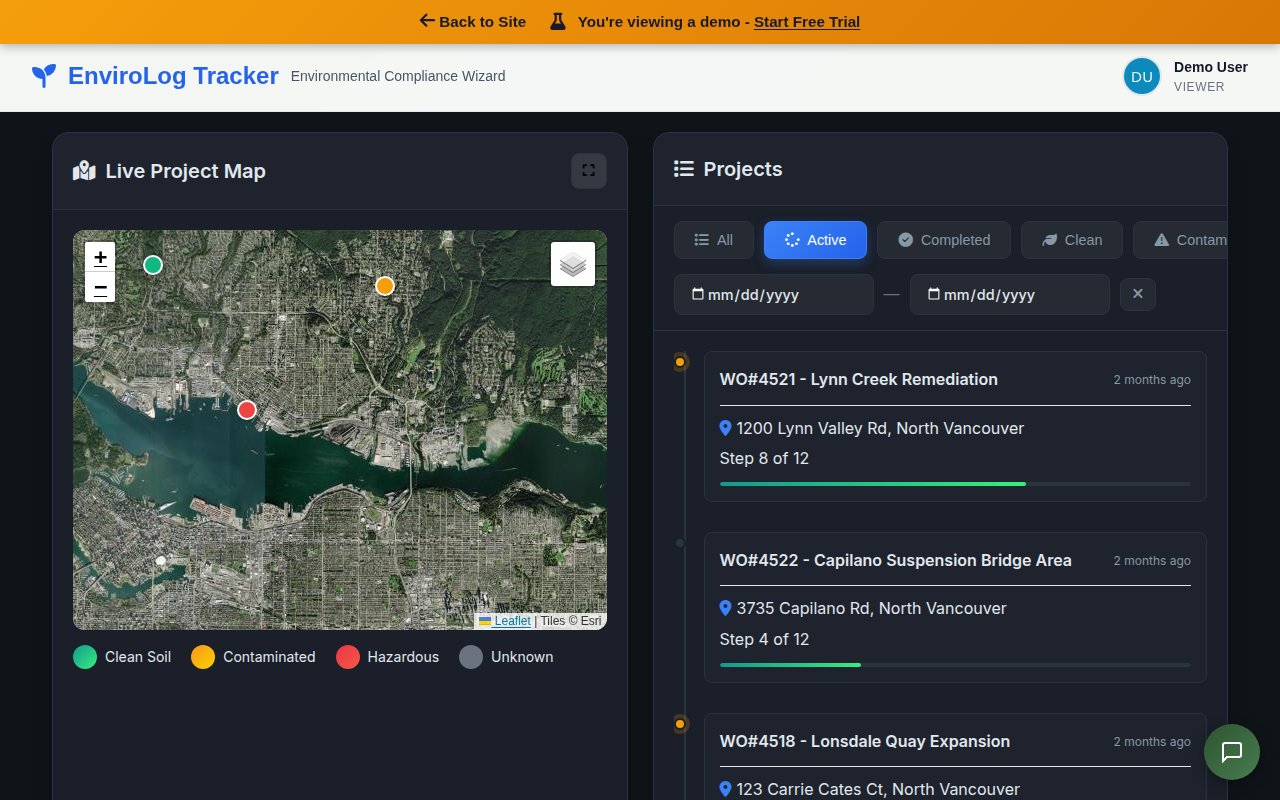
See How EnviroLog Tracks Chain of Custody
Digital COC, sample tracking and lab data - all in one dashboard.
Digitize Your Chain of Custody
NVES EnviroLog provides digital COC, lab data integration and sample tracking in one platform built for environmental professionals.
Start a Free Trial